If you can't say anything nice..
Reading a comment earlier about poor feedback on a paint job, relative to Facebook pages, or twitter, or wherever got me thinking. Like most hobbyists, I've had a journey in my painting style and quality over the years, but more importantly what I wanted to get out of every completed miniature.
A huge part of that improvement and self reflection has been constructive criticism from other great hobbyists. Providing constructive crit (CC as I will call it from here out,) is a skill in itself, and I wanted to pen some thoughts on it as it also happens to be part of my professional toolkit and responsibilities in my "real job."
Constructive Criticism
Dictionary.com defines the term as
"helping to improve; promoting further development or advancement"
We can probably all agree, on the face of that definition, the happy helping hand of a friendly community keen to see others do well.
Criticism,on the other hand, has several interpretations on its own. Chiefly for this article these humdingers;
"the act of passing judgement as to the merits of anything or
the act of passing severe judgement; censure; faultfinding"
We can see that simply providing criticism, without the constructive bit - might be factual, but its often not helpful. I read many threads of comments that have descended into flamewars against an individual that I honestly believe felt they were doing the right thing and I've felt the urge to wade in and try to waggle my coaching feedback stick at people. The internet being the internet however, this will only end one way and, frankly, I have better things to do with my life.
So how can I be more helpful? By providing my own constructive criticism on constructive criticism. On myself, of course. Its all gone a bit circular.
Lets look at some examples of this. And, for total fairness, I will hold myself out on the altar of self sacrifice by sharing some of my earlier abominations, my work as its developed, to my current standard (which is still far, far away from any number of talented people I could name)
 |
| Terminator re breathers didn't save this brother from suffocating beneath thick paint |
This poor unfortunate is not my first mini painted by any stretch but is from what I will call the late nineties era of my work.
Criticism - The paint is way too thick. No dept to the colour. Eye lenses not coloured. Poor, inconsistent black lining (I mean, black lining. if that and the red doesn't date it..) No script on purity seals. Gloss varnished.

Look I know hes awful. But look beyond and in context, IE; what redeeming factors could you consider to give some constructive feedback.
What nice things can I say?
My starting point in this situation is simple. First and foremost - promote. We're often reviewing peoples work on facebook, twitter, instagram, etc. Like it. Share it, retweet it.
 |
| The strange, positive glyph did not register in Bulruk the neckbeards dictionary. |
Secondly.
Neatness! if any painter can paint between the lines relatively cleanly, that's a brilliant start which will serve them well in all techniques, including non metallic metals, source lighting, you name it.. brush control is the basic technique, and neatness should be encouraged. I think layercake termie is actually, (in context!) pretty neat!
 |
| If they did good, they did good. |
Thirdly.
Colour choice. Colour theory, contrasting / complimentary colours, or a theme across the model, unit, or whatever are another brilliant basic tenet of painting miniatures that doesn't get any less important as you move onto more advanced techniques. Sure termie is bright red and has enough layers to suffocate a small animal, but the red is bright and consistent (good old blood angels red) and the purity seals are the right colour. Yes, feels like clutching at straws but, positive breeds positivity.
What have we got?
So we have a painted miniature which...could be better but we've found two relatively nice things to say about, without yet mentioning whats wrong with it. Obviously we still feel the burning need to help. How can we get that across?
The Sandwich
Many readers might know this coaching theory approach, which is actually a little old hat these days when you are talking about development for staff or mentored people, but a simplified theory that is generally applicable and works in this situation.
 |
| The Hamburger of Hope |
So we have our two positives already. Whats the biggest constructive issue we can pick from our friend the nearly departed Terminator? Thick paint.
By far the first and most regularly repeated criticisim levelled at any new painter. Honestly, they KNOW. "Thin your paints" is not a helpful thing to say. Thinning and painting with thinned paints is a big, mastering step it takes people along time to perfect.
So. We lead in with
1. "hey, that terminator looks really neat! good job! Those purity seals can be tricky can't they?
Positive. And acknowledging difficulty. Showing empathy.
Very, very very important.
 |
| If you take away one thing from this article |
2. How do you thin your paints down? if you need any help let me know, I can recommend some different techniques if you want, it would ABSOLUTELY help you get that script on the seals looking great!
Remaining positive. Recalling the neatness, offering advice but not shoving it down their throat, inviting them to ask for more. Most importantly, finishing on a reinforcing "I know you can do it" and yes, you've still mentioned that they need thinning more, but not in a really THAT LOOKS SHIT, WORTHLESS MORTAL. Way.
3. "love the bright red, get a little shading in there thats showing real promise! I wish I could get my red that...RED!
You get the picture, and yes I am really simplifying this for the purpose of my example.
Its really not complicated.
At this level, or at any level. Being understanding, showing empathy and providing constructive feedback gives that person a little kudos for being brave enough to share. It gives them something to work on and get better, and it reinforces that the whole experience was not a negative one..hopefully they'll do it again!
So to share some more of my own less than stellar past;
 |
| Why did I gloss varnish stuff?! |
 |
| Ahh, the verteran sergeant, Hes armless. |
 |
| Experiments in snow. |
Several of those staffers, including one multiple Golden Demon award winner spent quite a bit of time giving some of this constructive criticism to a 12 year old me. Much of this, including thinning paints, painting eyes, freehanding banners, many many other things, stuck with me, especially getting nice words on my awful models by these people who had won demons! I've been lucky enough to make contact with that first influence on hobbying me latley and say a massive thankyou - I hope staffers and people in those kind of positions know how much influence they have. (cheers again Chris)
As I got older and I could afford more paints, better brushes I got more confident in experimenting. I tried things, people seemed to think they were cool, so I kept trying with things like the freehand, which I always got positive feedback on, so I got better, and better.
 |
| Freehand Deathwing banner (2004ish) |
 |
| Sisters Rhino and freehand dozer blade and top hatch 2019 |
Here's a good example of the mechanic and how it has affected me. That positive reinforcement made me practice, get better. Fully happy with saying freehand is one of my strengths now, it doesn't scare me. However, around the same time someone tried to say "your basing is a little basic, the models look great but have you tried XYZ" what they actually said was
"your bases are always shit man, always the same, lets everything down"

To this day I am overly critical 110% of my basing of miniatures. Nothing ever looks right to me, try as I might, I really really hate it. And that has stuck with me too - there is negative, as well as positive reinforcement, so remember that before you choose to speak, or drop a comment on someones work. It might be benign to you, but it might not be for that person - I'm sure my friend doesn't know that he embedded himself in my psyche either.
Ask the really really good people how they did it!
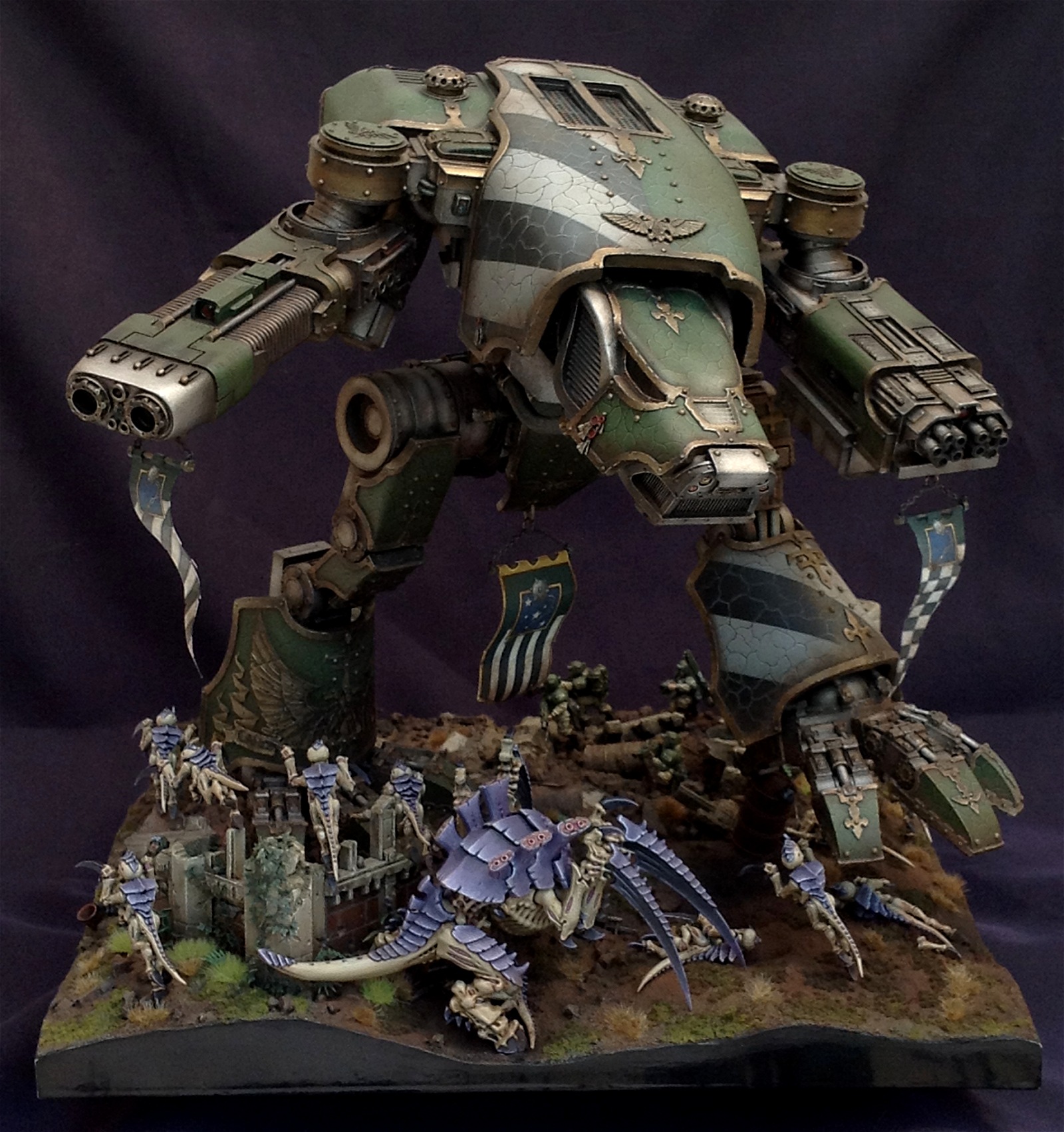
Some of the best help I've received was during the days of Platoon Britannica, and the many many amazing painters I chatted with there and met - to a soul every single one of them knew the savageries of painting and how to give someone this kind of feedback, because they all accepted that's where they started too. Standout people that really stuck in my mind were the likes of Maz (winterdyne - creator of this beast) Adrian Bay, Mark Lifton, and many, many others. I've asked the legend that is Darren Latham for feedback on recent entries and had some really useful help.
I'd like to think this later exposure to people willing to give me the benefit of their experience was whats led to feeling like I can contend at Golden Demon, getting 13 finalists pins and still hoping to win a statue one day. If you can approach it with a little thicker skin and take the pain, you will improve. I'm nowhere near where I want to be, but I can and will continue to get better.
Paintbrushes Down
My closing words as this ramble draws to is conclusion. In my experience, those who criticise harshly, who make you feel like dogshit and not want to pick up a paintbrush, they're not those guys. They're people who themselves are not confident, know they could be better and improve their skills and don't know how to articulate asking for help or have the self awareness to recognise their own faults. The real masters of the hobby are always always the better for helping others meet them at that level and surpass them.
 |
| Golden Demon Finalist, 2013 |
Paintbrushes Down
My closing words as this ramble draws to is conclusion. In my experience, those who criticise harshly, who make you feel like dogshit and not want to pick up a paintbrush, they're not those guys. They're people who themselves are not confident, know they could be better and improve their skills and don't know how to articulate asking for help or have the self awareness to recognise their own faults. The real masters of the hobby are always always the better for helping others meet them at that level and surpass them.


Comments
Post a Comment